The kids knew the idea behind Plimoth Plantation, the historical living museum in Plymouth, Massachusetts, where modern people dress in the clothes of long ago and interpret the past. That means you can ask them about TVs and they will look puzzled. Or mention President Obama and they won't know who that is, or even what the United States is, because they are living in 1627, seven years after the Mayflower arrived in the New World.
All our third graders saw a replica, or copy, of the Mayflower. They were able to study it outside...
and in.
In the village, it took our kids a little while to get used to the fact that modern people were buried so deep beneath their costumes, that visitors felt as if they were talking to someone who had actually lived in Plimoth almost 400 years ago. These modern people had studied so much that they could answer any questions the kids had.
Once the kids understood that, the questions came fast and furious. One group cornered a village resident for at least minutes. What does he eat everyday? What is he building (a house). How does he use his knife? What was it like coming over on the Mayflower? Was it scary?
They moved on to a women tending her garden. Was she angry at King James, they asked. Not really, she said. Royals do not pay much mind to common folk such as themselves. The villagers had much more anger toward the leaders of their church. They left England, in fact, because they were not allowed to worship the way they wanted to.
The kids learned that this woman also tended her farm animals: cows, sheep, and chickens. Then one student asked if it was possible to be a cow and a bull at the same time. The woman smiled a little. "Well, maybe we'd call that situation a steer," she said.
The kids listened to a man from the Wampanoag tribe he told them how he was making a mishoon - the Wampanoag word for boat - by using fire as a tool to hollow out a tree.
What did Wampanoag kids do? What kind of games did they play long ago? Our Perkins kids got to check out the homemade dolls and toy mishoon they would have used.
That was cool, but the fact that amazed them most of all was that in this Native American culture, there was no breakfast, lunch, and dinner. There was always food on the fire, so people could eat whenever they were hungry.
This was an amazing trip into the past, but it was part of school as well. Each of our students had a journal. They all had to sketch the Mayflower, label its parts, and compare the lifestyle of the Pilgrims and the Native Americans.
The long ride back to South Boston was much quieter than the one to Plimoth. The kids had a lot to think about. Also, they were pretty tired. It had been quite a day
Showing posts with label interviews. Show all posts
Wednesday, November 28, 2012
Tuesday, April 10, 2012
Evacuation Day Reflections #1
Our school play, Evacuation Day, the Musical, is over, but its effects are not. You can still hear a few kids humming as they move through the halls. A few more copies of the Perkins School's book, Why Do We Celebrate Evacuation Day?, can be seen on shelves and desks than usual.
Other outcomes may not be as visible, but they are just as important, maybe even more. Being in a play, trying hard, working in a group--these actions have an effect too. Occasionally, for a while, we'll report on how some of the kids felt being involved in the production.
To start off, here's Shakira, who played patriot Henry Knox.

When I was in the Jungle Book show last year, I quit because I was too shy. I think it was the day of the show that I quit. But this year, it was different because my friends were there, and they were saying, “It’s okay,” and that I don’t need to be shy. When I got on stage, I wasn’t shy at all – also because my Mom was there. The first time, it felt like only she was watching me, so I was able to concentrate. The day that the mayor came, I was able to focus because I was so excited, He was in the front seat. I knew that I would be able to focus if I looked at the crowd and at him. I kind of felt inspired. I knew that if I did a good job, we would be able to do another performance because the mayor might think we did a good job. I also knew I would do a good job because I was playing Henry Knox and Henry Knox is the leader. He was the brains of Evacuation Day – so I knew I couldn’t be shy and give up because the colonists needed me!
Other outcomes may not be as visible, but they are just as important, maybe even more. Being in a play, trying hard, working in a group--these actions have an effect too. Occasionally, for a while, we'll report on how some of the kids felt being involved in the production.
To start off, here's Shakira, who played patriot Henry Knox.

When I was in the Jungle Book show last year, I quit because I was too shy. I think it was the day of the show that I quit. But this year, it was different because my friends were there, and they were saying, “It’s okay,” and that I don’t need to be shy. When I got on stage, I wasn’t shy at all – also because my Mom was there. The first time, it felt like only she was watching me, so I was able to concentrate. The day that the mayor came, I was able to focus because I was so excited, He was in the front seat. I knew that I would be able to focus if I looked at the crowd and at him. I kind of felt inspired. I knew that if I did a good job, we would be able to do another performance because the mayor might think we did a good job. I also knew I would do a good job because I was playing Henry Knox and Henry Knox is the leader. He was the brains of Evacuation Day – so I knew I couldn’t be shy and give up because the colonists needed me!
Monday, June 27, 2011
A Publishing Party!
Brainstorm, for example, was what they did to come up with all the ideas they thought should be in the book.
Observed was what they did everyday for a week and a half, going down and watching the workers at the site. This inspired many of their questions.
Inquired was their asking Mr. O'Toole and Mr. Moore lots and lots of questions, such as whether they work in the rain and in the summer and if they have first aid kits on site.
Teamwork was what happens on the construction site and also what happened in the classroom when the kids worked together to write their sections and edit each others' work by "making the works better."
And results were their reward, what they got by asking good questions and working hard. The best results? The book itself.
Mr. O'Toole and Mr. Moore both said that they were very proud to have a copy. In fact, Mr. Moore said that everyone else on the construction site would be jealous! We hope that he'll share.
That day, every kid felt like an author!
NOTICE!!! This is a busy week, so we're going to have posts every day for a while. Make sure you keep checking in!
Monday, June 20, 2011
It's the Culture Alert, Part 3
Perhaps you remember that Ms. Alert's third grade class is studying different cultures. When the kids realized that so many of their parents or grandparents came from a different culture, they decided to interview them about some of the differences in habits and attitudes found in their home countries. Then our author-in-residence, Ms. Goodman, showed them how to conduct an interview by doing one with Ms. Alert, who was born in Guyana.
Well, the first reports are in--
Here is Shakira's interview about life in Belize:


Looks like their houses were on stilts; they didn't really celebrate birthdays; and, they had huge breakfasts. Also sounds like people are a bit less polite here. Click on the papers, to make it easy to read the details.
And here is what Hibaq learned about living in Somalia:


When you come from Somalia to the United States, the cold is really hard to get used to. And kids there wear uniforms when they go to school.
Well, some things are very different. What will some of the rest of the kids find out from interviewing their families?
And what kind of things will they discover are the same--all over the world?
Well, the first reports are in--
Here is Shakira's interview about life in Belize:
Looks like their houses were on stilts; they didn't really celebrate birthdays; and, they had huge breakfasts. Also sounds like people are a bit less polite here. Click on the papers, to make it easy to read the details.
And here is what Hibaq learned about living in Somalia:
When you come from Somalia to the United States, the cold is really hard to get used to. And kids there wear uniforms when they go to school.
Well, some things are very different. What will some of the rest of the kids find out from interviewing their families?
And what kind of things will they discover are the same--all over the world?
Thursday, June 9, 2011
The Construction Book's Next Chapter
Wow, it sure takes a long time to write and illustrate a book. That's what Ms. Murphy's second graders are learning.
If you remember from past posts, the class is collaborating on a book about what construction workers do and how they stay safe. The kids did the same kind of research that grownup writers do. They observed the workers doing their jobs and took notes. Then they interviewed two experts--Mike Moore and John O'Toole--who came to their classroom.

Before that visit, the students thought about important things they should know about the topic. They each asked a question and did their best to write down the information they heard. Later Ms. Murphy put them in teams of two, to work together writing up the answers. Then they handing in their papers and Ms. Murphy typed them up.
But now the kids are learning that just because something looks neat and tidy doesn't mean that it is done. They call it a "rough draft" for good reason.
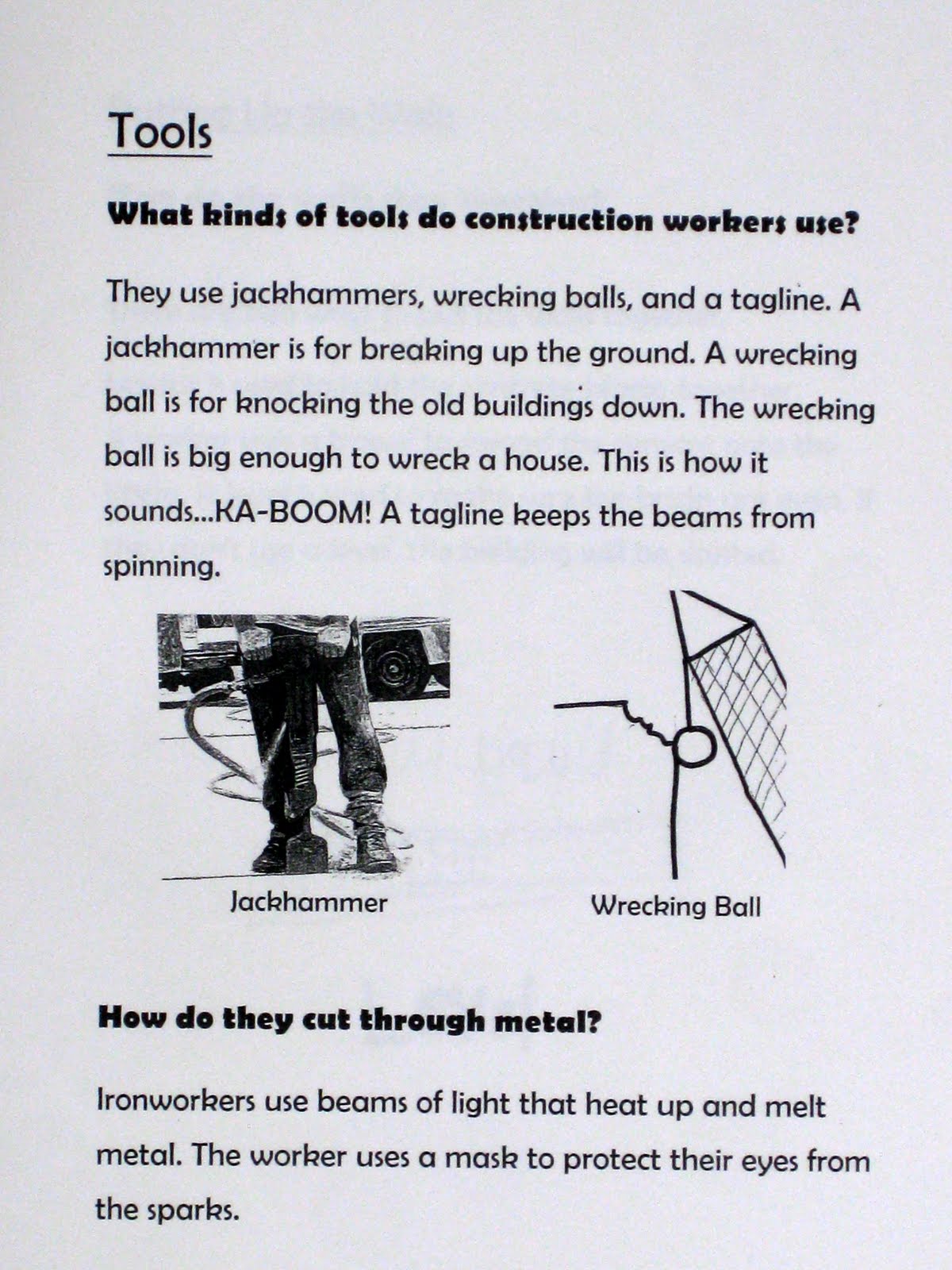
Professional writers hand in their manuscripts to editors at publishing companies. These editors are sort of like teachers. They read the text and give suggestions about how to make it better. Ms. Murphy did this too. Here is an example of a page of the book and Ms. Murphy's ideas (IN CAPITAL LETTERS) of what needs to be done. Hey kids, it happens to every writer--improving your work is just part of the job.

Of course, books need pictures and unlike some professional writers the kids are illustrating their book themselves. Printing in color is expensive for any publishing company so the kids are doing line drawings. Here is a preview of some of their work:

This picture shows an iron worker "tying off," attaching a safety strap onto the steel. That way, if they slip off the building they don't fall all the way to the ground.
This drawing compares the construction workers to a colony of ants. For one thing, both are always very busy. For another, they both have members who all work at different jobs to make one thing a success.
Cool idea, kids!
If you remember from past posts, the class is collaborating on a book about what construction workers do and how they stay safe. The kids did the same kind of research that grownup writers do. They observed the workers doing their jobs and took notes. Then they interviewed two experts--Mike Moore and John O'Toole--who came to their classroom.
Before that visit, the students thought about important things they should know about the topic. They each asked a question and did their best to write down the information they heard. Later Ms. Murphy put them in teams of two, to work together writing up the answers. Then they handing in their papers and Ms. Murphy typed them up.
But now the kids are learning that just because something looks neat and tidy doesn't mean that it is done. They call it a "rough draft" for good reason.
Professional writers hand in their manuscripts to editors at publishing companies. These editors are sort of like teachers. They read the text and give suggestions about how to make it better. Ms. Murphy did this too. Here is an example of a page of the book and Ms. Murphy's ideas (IN CAPITAL LETTERS) of what needs to be done. Hey kids, it happens to every writer--improving your work is just part of the job.
Of course, books need pictures and unlike some professional writers the kids are illustrating their book themselves. Printing in color is expensive for any publishing company so the kids are doing line drawings. Here is a preview of some of their work:

This picture shows an iron worker "tying off," attaching a safety strap onto the steel. That way, if they slip off the building they don't fall all the way to the ground.
This drawing compares the construction workers to a colony of ants. For one thing, both are always very busy. For another, they both have members who all work at different jobs to make one thing a success.
Cool idea, kids!
Monday, June 6, 2011
Culture Alert, Part 2: Learning to Interview
On May 10th, the PerkinsBlog reported on the new project started by Ms. Alert's class. These third graders were looking at cultures around the world, and how diverse customs, beliefs, and habits make people act and live differently. Yet in many ways, all people are the same.http://www.blogger.com/img/blank.gif
Many of the kids in Ms. Alert's class had parents and grandparents that came from different countries. They decided to talk to their families to discover the ways life was different there.
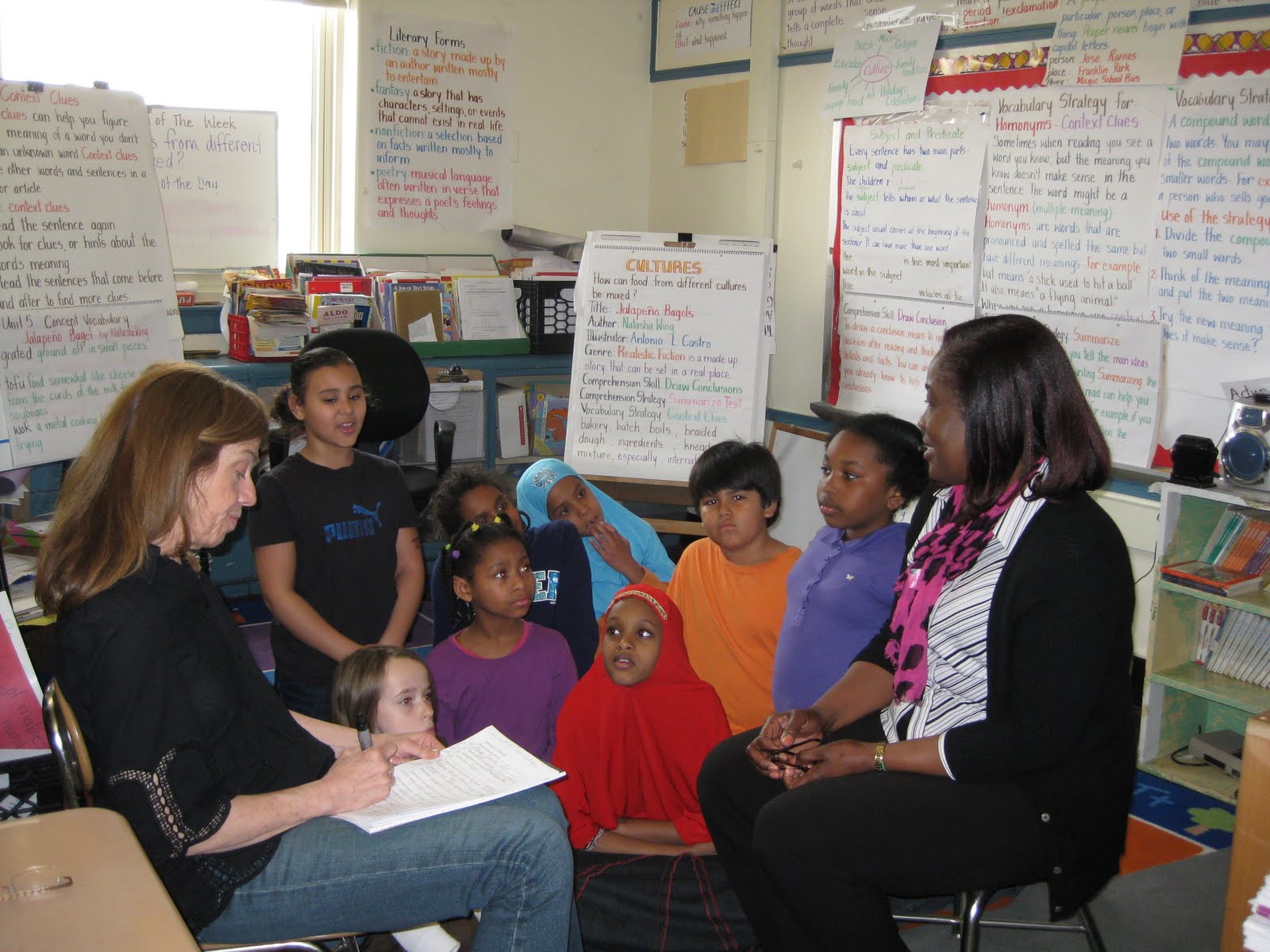
But how do you conduct an interview? Ms. Goodman, Perkins' author in residence, has done a lot of interviews to research her books. She knows a lot of good tips. She came to class to interview Ms. Alert, who was born and raised in British Guyana.

Ms Goodman had her questions ready. In fact, they were the same questions the class is going to use when talking to members of their own family. She used those questions, but she didn't just ask them, write down an answer and move on. She used them to start a conversation with Ms. Alert. This got Ms. Alert thinking and talking about her life in British Guyana so she came up with lots more examples than she might have with just one question.
Ms. Goodman wrote down the answers but she didn't try to write down every word. If she had, it would have taken her too long and she wouldn't have been able to hear what Ms. Alert said next. She put down the most important words of each answer. These words would help her remember what Ms. Alert said for when she wrote it up as a report later. (You can read her notes if you click on the image to make it larger.)

Also, once Ms. Alert started talking something she'd often mention a detail that was part of an answer to a question she had already been asked. Then Ms. Goodman went back and jotted it down where it belonged. For example, when Ms. Alert said that she came to the United States in 1996, Ms. Goodman added to the section about where she had lived before.

If Ms. Goodman didn't have enough room to write down the answers, she used the margins--or drew a line to where the rest of the answer would be.
The kids weren't just learning about how to interview. They were also learning about British Guyana, its culture, AND their teacher. In British Guyana, for example, people ate their big meal of the day at lunchtime and everyone flew kites on Easter Monday! Furthermore Ms. Alert's middle name is Cleoretta!!! Soon their hands were up all the time with questions and all Ms. Goodman had to do was take notes.
If we found out so much about Ms. Alert and her culture in just one hour, what are the kids going to learn about THEIR families?
Many of the kids in Ms. Alert's class had parents and grandparents that came from different countries. They decided to talk to their families to discover the ways life was different there.
But how do you conduct an interview? Ms. Goodman, Perkins' author in residence, has done a lot of interviews to research her books. She knows a lot of good tips. She came to class to interview Ms. Alert, who was born and raised in British Guyana.

Ms Goodman had her questions ready. In fact, they were the same questions the class is going to use when talking to members of their own family. She used those questions, but she didn't just ask them, write down an answer and move on. She used them to start a conversation with Ms. Alert. This got Ms. Alert thinking and talking about her life in British Guyana so she came up with lots more examples than she might have with just one question.
Ms. Goodman wrote down the answers but she didn't try to write down every word. If she had, it would have taken her too long and she wouldn't have been able to hear what Ms. Alert said next. She put down the most important words of each answer. These words would help her remember what Ms. Alert said for when she wrote it up as a report later. (You can read her notes if you click on the image to make it larger.)

Also, once Ms. Alert started talking something she'd often mention a detail that was part of an answer to a question she had already been asked. Then Ms. Goodman went back and jotted it down where it belonged. For example, when Ms. Alert said that she came to the United States in 1996, Ms. Goodman added to the section about where she had lived before.

If Ms. Goodman didn't have enough room to write down the answers, she used the margins--or drew a line to where the rest of the answer would be.
The kids weren't just learning about how to interview. They were also learning about British Guyana, its culture, AND their teacher. In British Guyana, for example, people ate their big meal of the day at lunchtime and everyone flew kites on Easter Monday! Furthermore Ms. Alert's middle name is Cleoretta!!! Soon their hands were up all the time with questions and all Ms. Goodman had to do was take notes.
If we found out so much about Ms. Alert and her culture in just one hour, what are the kids going to learn about THEIR families?
Subscribe to:
Posts (Atom)