Showing posts with label history. Show all posts

Monday, March 11, 2013

Compare and Contrast, One Year Later

If you scroll down to the previous post, you will see our report on Ms. Leverett-King's first grade class and their adventures with Common Core State Standard Ri.1.9: Identify basic similarities in and differences between two texts on the same topic (e.g., in illustrations, descriptions, or procedures).

A note: For those who don't know, Common Core State Standards are the new guidelines for what students should learn and when.  These standards will go into effect in most states of our nation in 2014.

Well, first graders aren't the only kids who must learn to compare and contrast.  Second graders are learning the same lesson, but with more complexity.  Ri.2.9, the second grade version, asks students to "Compare and contrast the most important points presented by two texts on the same topic."  

That's what Ms. Murphy's class did when looking at two of our most famous presidents: George Washington and Abraham Lincoln.

Remember, you can click on any picture to make it larger.

First they were presented with different written materials.  Their job was to read them carefully and sort them into similarities and differences.  They were supposed to pick the most important points.  Sometimes what's more important is a matter of opinion, though.

The kids learned to present their findings by making their own Ven diagrams.  Even knowing what a Ven diagram is and being able to use it yourself is a big step forward.  That's what a year can do. 

Here are some of the students' examples: 


Wednesday, February 27, 2013

Common Core, Here We Come

As we've mentioned before, Common Core State Standards have been adopted in 45 states of our nation.  They will define the teaching standards for all the schools in these states.  They are supposed to start in 2014, but the Perkins School isn't waiting.  

Just look at another display of assignments from Ms. Bishop's third grade class.  Not only are they learning the roots of the American Revolution, they are satisfying some of the learning requirements set for third grade students.

Remember, you can click on any picture to make it appear larger.


Go Ms. Bishop!  Go kids!

Tuesday, February 12, 2013

Black History Month

February is Black History Month.  All around the Perkins School, students celebrate African-American pioneers in science, literature, sports, and civil rights.


Ms. Smith's kindergarten class concentrated upon one African-American hero that made a lot of history--more than a month's worth. After learning about Dr. King, each of them wrote about the part of his legacy that impressed them the most.  Here are a few examples:

Remember, you can click on any picture to make it larger.


Thursday, January 17, 2013

Common Core? We're Working on It!


If you aren't in the education field, you might not know that we have new national standards to help improve our kids' learning.  They are called the "Common Core State Standards."  Teachers are learning how to incorporate them into lesson plans. So our teachers and kids are learning together!


Remember, you can click on any photo to make it larger.

Mrs. Murphy's second grade class read some information about the Pilgrims.  Then they applied the new second grade KEY IDEAS AND DETAILS standard to what they read.  The kids were asked to identify the main topic of a multi-paragraph text as well as the focus of specific paragraphs within the text.

Mrs. Murphy made it more fun by having the kids write (and illustrate!) their own books. Their titles labelled their interpretations of the key idea: The Pilgrims Difficult Lives, for example, The Pilgrims Story, The Pilgrims Journey.  Then each following page identified the main idea of each paragraph.  The kids learned to pick out the important information and will eventually be able to take home book of their own.

Here are a few pages from two students' work:


Wednesday, November 28, 2012

Plimoth Plantation: A Field Trip Back in Time

The kids knew the idea behind Plimoth Plantation, the historical living museum in Plymouth, Massachusetts, where modern people dress in the clothes of long ago and interpret the past.  That means you can ask them about TVs and they will look puzzled.  Or mention President Obama and they won't know who that is, or even what the United States is, because they are living in 1627, seven years after the Mayflower arrived in the New World.


All our third graders saw a replica, or copy, of the Mayflower. They were able to study it outside...


and in.

In the village, it took our kids a little while to get used to the fact that modern people were buried so deep beneath their costumes, that visitors felt as if they were talking to someone who had actually lived in Plimoth almost 400 years ago.  These modern people had studied so much that they could answer any questions the kids had.


Once the kids understood that, the questions came fast and furious.  One group cornered a village resident for at least minutes. What does he eat everyday?  What is he building (a house).  How does he use his knife?  What was it like coming over on the Mayflower?  Was it scary?


They moved on to a women tending her garden.  Was she angry at King James, they asked.  Not really, she said.  Royals do not pay much mind to common folk such as themselves.  The villagers had much more anger toward the leaders of their church.  They left England, in fact, because they were not allowed to worship the way they wanted to.

The kids learned that this woman also tended her farm animals: cows, sheep, and chickens. Then one student asked if it was possible to be a cow and a bull at the same time.  The woman smiled a little.  "Well, maybe we'd call that situation a steer," she said.


The kids listened to a man from the Wampanoag tribe he told them how he was making a mishoon - the Wampanoag word for boat - by using fire as a tool to hollow out a tree. 


What did Wampanoag kids do?  What kind of games did they play long ago?  Our Perkins kids got to check out the homemade dolls and toy mishoon they would have used. 

That was cool, but the fact that amazed them most of all was that in this Native American culture, there was no breakfast, lunch, and dinner.  There was always food on the fire, so people could eat whenever they were hungry.


This was an amazing trip into the past, but it was part of school as well.  Each of our students had a journal. They all had to sketch the Mayflower, label its parts, and compare the lifestyle of the Pilgrims and the Native Americans.  

The long ride back to South Boston was much quieter than the one to Plimoth.  The kids had a lot to think about.  Also, they were pretty tired. It had been quite a day

Monday, November 26, 2012

Another Way to Give Thanks

The Perkins kids left for the long Thanksgiving weekend thinking of turkey, stuffing (and, of course, a mini-vacation). Now, however the kids also knew that other Americans had  different fall harvest holidays to celebrate.

Ms. Jannette Vanderhoop is a member of the Wampanoag Tribe of Aquinnah / Gay Head on Martha’s Vineyard.  She came to talk to the Perkin kids about what it means to be a member of a Native American tribe – in the present 21st century and at the time the Pilgrims arrived in North America in the 17th century.


Her book Cranberry Day explains the major thanksgiving festival the Wampanoag Tribe celebrated long before the Pilgrims came to their land. In the old days, the celebration of the cranberry harvest was three days long.  Nowadays it is just one, but it is still lots of fun.  Kids don't go to school.  Elders of the tribe share stories of the past with them and everyone eats a feast--including cranberries, of course.


Ms. Vanderhoop also brought some of the cloths and traditional jewelry her people used to wear.


After she left, the kids had their own celebration; many classes turned much of what they learned into beautiful bulletin board displays.


Ms. Leverett-King's class demonstrated that the cranberry can be used for another purpose besides food and a good way to get enough vitamin C.


It can also be used for painting!

Thursday, June 7, 2012

Another Trip Around the World with Ms. Meadow's Class

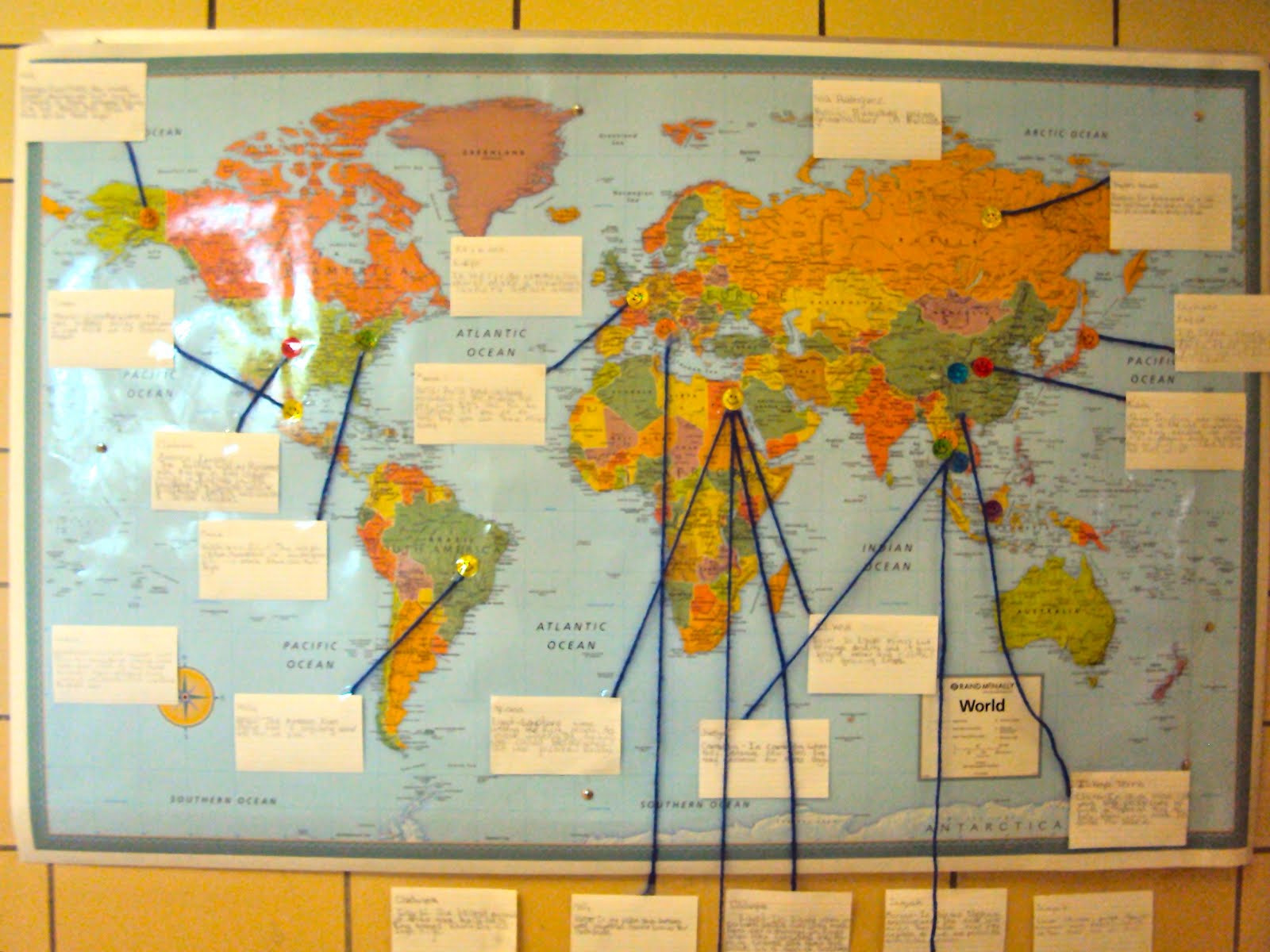
If you remember, there's a big geography project going on in (and right outside) Ms. Meadow's room. Since people from all around the world are taking an interest in us by visiting our blog, these third graders are returning the favor. They are researching the countries that have shown up on our visitors list and writing down an amazing fact about each one.
Amazing facts about the world keep coming in...


Have you ever seen one? This is what it looks like:


Have you ever seen hieroglyphics? They look like this:


Moving on to Europe, Mecca wrote about the view from a famous Paris monument.

There are lots of views, of course, but this one includes another famous monument, the Eiffel Tower.


We don't have an illustration of this last fact. Perhaps that's all for the best!

Wednesday, May 2, 2012

The World in Ms. Meadow's Classroom

If you remember, there's a big geography project going on in (and right outside) Ms. Meadow's room. Since people from all around the world are taking an interest in us by visiting our blog, these third graders are returning the favor. They are researching the countries that have shown up on our visitors list and writing down an amazing fact about each one.

For example, did you know this?


You would think that fortune cookies came from China because, in the United States, we usually get them in Chinese restaurants. Well, you learn something new every day!


On the other hand, the Chinese people managed to come with some pretty delicious things to eat. This is what Cladwyne discovered:


Speaking of snow...
Most of our readers come from the United States. The kids decided that there are plenty of interesting things to learn about our country. Check this out:


How about making that into ice cream!?!

Tuesday, May 1, 2012

Evacuation Day Reflections #4

Our school play, Evacuation Day, the Musical, is long over, but it is not forgotten. Furthermore, its effects can last for a very long time. Being in a play, trying hard, working in a group--these actions have reap rewards that might be even more important than the applause. Here is our last in the series of interviews with kids about how they felt being involved in the production.

This time we hear from Sophia, a wonderfully enthusiastic performer.


I’m glad that I was in the play because it was fun. It was like acting. I like acting because you can move around. Sometimes it was hard to remember the lines. I was a little bit scared, but then my parents said, “Good job.” Now the first graders will know the play when they are second graders next year.

Wednesday, March 21, 2012

The Play Continued

The kids learned a lot of history while doing Evacuation Day, the Musical. They learned about how the colonialists increasingly resented the British having power over them. They also learned how the colonialists managed to drive the British out of Boston without bloodshed.

How? Well, here's the short story. Take a look...


#1 General Howe and the Redcoats bragged about their power over the colonists.
A mistake!


#2 The colonialists didn't like the British attitudes and actions.


#3 The colonists asked General George Washington for help kicking the British out of Boston.


#4 Henry Knox worked with General Washington in protecting Boston and the colonists by bringing cannons over the Berkshire Mountains to Boston. The British had no idea this was happening!


#5 Eventually the British found out the hard way. The colonialists faced off against them on Dorchester Heights (which is right near the Perkins School!) Guess who won!


The Redcoats left Boston and the curtain goes down on our play and this incident in history.

The play is over for this year. Amazingly enough, the kids got to sing a few of the best songs from it once more--this time in front of Boston's Mayor Menino AND the Governor of Massachusetts.

When? How? You'll just have to wait until tomorrow to find out!