Showing posts with label Susan E. Goodman. Show all posts

Tuesday, January 15, 2013

An Author's Visit

Some of our younger kids see Ms. Goodman in the halls or in their classrooms and know she help writes the PerkinsBlog.  They forget, however, that she has another part of her working life.  She writes books; she is an author.  Recently she visited Ms. Haney's first grade class to talk about her "other job."


She explained that all books start with ideas.  Sometimes a publisher, or book company, comes to her with an idea and asks her to write about it.  That's how she came to write about monster trucks, for example.


"These books are fun and I learn a lot," she said, but her favorites are often the books when she came up with the idea herself.  The kids liked the idea behind All in Just One Cookie.  It is actually two stories in one.  The first is a grandmother making chocolate chip cookies for her grandchildren.  Then each time Grandma puts a new ingredient in the bowl, we find out where that butter or chocolate came from.  Did you know that baking soda comes from a giant lake in Wyoming that dried up 50 million years ago?


Ms. Goodman read the kids another book based on one of her own ideas, Nature Did It First.  She showed them a picture of a human using an object or device, say, a woman carrying her baby in a Snugli.  Then the kids could guess what animal carries her baby this way--a kangaroo!  

Here Ms. Goodman showed a picture of a boy on skates protected by a helmet, shin guards, and elbow pads.  The caption said, "Armor."  What animal also protects itself with a hard outer core?


The kids had a lot of answers for that one.  Turtles, snails, crabs, beetles. Those were all right answers.  It turned out Ms. Goodman had picked another one for her book, though.  The armadillo!


Finally it was time for the kids to start working on ideas of their own.  Ms. Goodman asked them to come up with ideas for another book: People Did It Second. She showed them pictures of animals doing something and asked them to come up with human equivalents.  For example, in this picture, a mother gorilla has built a nest of branches and leaves for her and her baby to sleep on.  What do people have that is similar?


The kids came up with several ideas.  They also came up with some great ideas for what humans have that works like a pelican's pouch and the emperor penguin's practice of having a few adults taking care of lots of kid penguins.  As you can see, our first graders had many suggestions for that one.  

Good ideas, kids! 

Monday, April 2, 2012

Hello Again

Sorry our blog went silent last week. What happened?


Some times a picture is worth a thousand words, especially when the Perkins blogmaster and author-in-residence is typing this post with one finger.

It's up and running now; we'll figure something out!

Monday, June 6, 2011

Culture Alert, Part 2: Learning to Interview

On May 10th, the PerkinsBlog reported on the new project started by Ms. Alert's class. These third graders were looking at cultures around the world, and how diverse customs, beliefs, and habits make people act and live differently. Yet in many ways, all people are the same.http://www.blogger.com/img/blank.gif

Many of the kids in Ms. Alert's class had parents and grandparents that came from different countries. They decided to talk to their families to discover the ways life was different there.

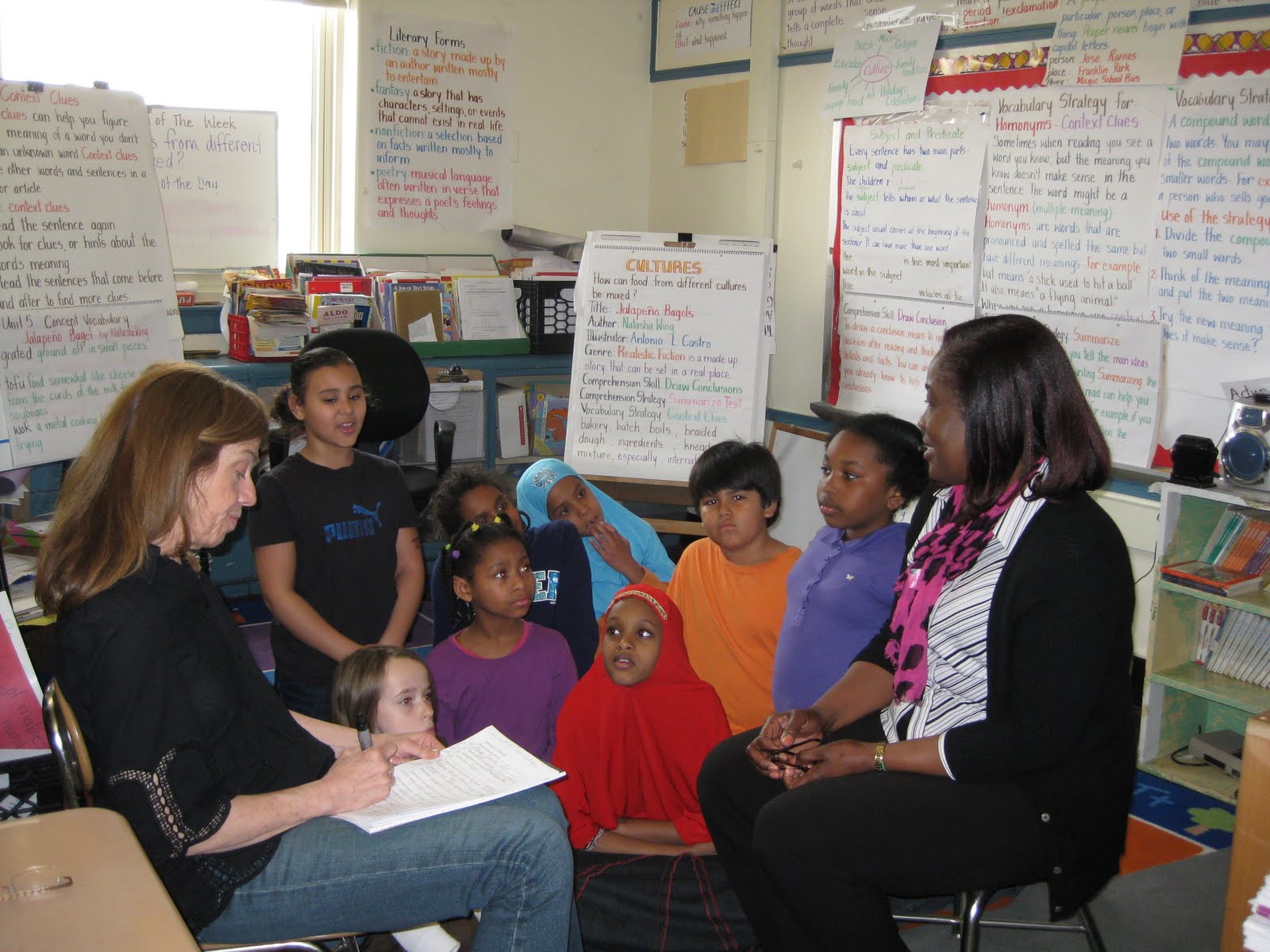
But how do you conduct an interview? Ms. Goodman, Perkins' author in residence, has done a lot of interviews to research her books. She knows a lot of good tips. She came to class to interview Ms. Alert, who was born and raised in British Guyana.


Ms Goodman had her questions ready. In fact, they were the same questions the class is going to use when talking to members of their own family. She used those questions, but she didn't just ask them, write down an answer and move on. She used them to start a conversation with Ms. Alert. This got Ms. Alert thinking and talking about her life in British Guyana so she came up with lots more examples than she might have with just one question.

Ms. Goodman wrote down the answers but she didn't try to write down every word. If she had, it would have taken her too long and she wouldn't have been able to hear what Ms. Alert said next. She put down the most important words of each answer. These words would help her remember what Ms. Alert said for when she wrote it up as a report later. (You can read her notes if you click on the image to make it larger.)


Also, once Ms. Alert started talking something she'd often mention a detail that was part of an answer to a question she had already been asked. Then Ms. Goodman went back and jotted it down where it belonged. For example, when Ms. Alert said that she came to the United States in 1996, Ms. Goodman added to the section about where she had lived before.


If Ms. Goodman didn't have enough room to write down the answers, she used the margins--or drew a line to where the rest of the answer would be.

The kids weren't just learning about how to interview. They were also learning about British Guyana, its culture, AND their teacher. In British Guyana, for example, people ate their big meal of the day at lunchtime and everyone flew kites on Easter Monday! Furthermore Ms. Alert's middle name is Cleoretta!!! Soon their hands were up all the time with questions and all Ms. Goodman had to do was take notes.

If we found out so much about Ms. Alert and her culture in just one hour, what are the kids going to learn about THEIR families?

Tuesday, May 10, 2011

It's the Culture Alert!


Ms. Alert's third grade class is studying culture. They are reading books, thinking and talking about what it means to have a culture. What kind of customs and practices make up a culture. How all these things help create people's ideas and attitudes and make them who they are.


When Ms. Goodman, Perkins' author-in-residence, heard about these lessons, she knew she had something to contribute. She brought one of her books to read to the class. Chopsticks for My Noodle Soup is the story of 5-year old Eliza who moved with her family from the United States to live in a jungle village in Malaysia for a year.


The kids in Ms. Alert's class discovered that kids in Malaysia (and all over the world) do the same kinds of things each day, but they often do them differently. People in Malaysia live in houses of course, but many of them on stilts. And the people prefer to sit on the floor instead of couches. Eliza ate rice for breakfast instead of the cereal she would have had at home. The kids at Perkins thought that was weird at first but then they realized it was just different. And that rice is pretty tasty! They thought that having a toilet in a separate little house was odd too, but they were definitely jealous that kids could buy as much candy as they wanted at school!

Noticing that the kids in Ms. Alert's class looked like a mini-United Nations, Ms. Goodman asked how many of them had parents who had not been born in the U.S. Close to half of them raised their hands. Then she asked how many of them had grandparents who hadn't been born here and even more hands reached toward the ceiling!

That was when the Culture Alert Project was born. After MCAS, the kids are going to learn even more about different cultures by interviewing their own families and sharing the results.

Stay posted!