Showing posts with label U.S. History. Show all posts

Friday, March 22, 2013

Another Place to Learn about Boston's Role in the Revolution

Due to Evacuation Day, The Musical, just about all the kids at the Perkins--even the kindergarteners--know that the American colonists were unhappy about their treatment by the British Empire.  Ms. Bishop's third grade class knows a bit more.

Remember, you can click on any picture to make it larger.

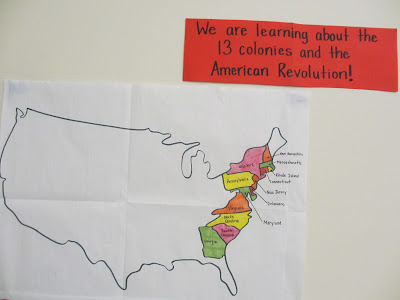
These kids are learning about the events leading up to the American Revolution.  Want to know something about the Boston Massacre and the Boston Tea Party, two major incidents that happened in our hometown?  Just ask Ms. Bishop's students.


Wednesday, March 20, 2013

The Play is the Thing...


Did you every hear of a victory with no blood?
Did you think it could happen--
Did you ever think it really would?

Don't you know that it happened right here?
1776  was the year!
Let's all give a rousing cheer:

E - VAC - UA - TION  DAY!

Remember, you can click any picture to make it larger.


The kids had been practicing hard: Going over their lines and how they should say them.  Memorizing the lyrics to all the original songs and rehearsing the dance moves that accompany them.  All the while, they were learning the amazing historical events that happened right near the Perkins School, and one of the most unusual battles of the American Revolution.

As Principal Brawer explained while welcoming friends and parents to the production, "History is filled with many battles, in which many people were killed, and yet they accomplished nothing.  What happened here at Dorchester Heights was a battle where no one was killed and it forced the British to leave Boston.  That's something important to celebrate.  This play also proves Evaculation Day is a real holiday."


So the story began, explaining that the British had created many laws and taxes the colonists felt were unfair.  As they said in this song:

We are in charge!
We make the best decisions.
We just want your provisions.
So bite your tongue and drink some tea for...
We are in charge!

 
The colonialists were angry, but confused about what to do.  Fighting a giant empire with many ships, soldiers, and weapons is not the easiest thing to do.  Luckily Henry Knox (right) came up with a daring plan and George Washington (left) was smart and daring enough to agree to put it into place.

The Americans had just taken Fort Ticonderoga away from the British.  There were 50 cannons at the fort.  They were 300 miles away, but if the colonialists could bring those cannons to Boston, they would have a chance.


Walking 300 miles to Fort Ticonderoga was bad enough, dragging 119,000 pounds of cannons across snow and mountains, Lake George, and the Hudson River was a very, very, very hard job.

 
Finally, one night, they snuck all the cannons up to the top of Dorchester Heights.


The next morning, the British saw the colonists ready for battle.  British cannons couldn't shoot uphill, but the colonists' cannons were aimed, ready, and able to fight. The British understand their predicament and left Boston.  A victory with no blood.

 
Yes, the British left Boston and they weren't happy about it.  In our school play, they were happy to come back for the grand finale, a song called "One Clever Idea."

One clever idea--can change the course of history!
One clever idea--and a lot of hard work set us free.

First you have a dream.
Then you make it come true.
Join together with thousands of hands.
It can happen to YOU! 

Dreams come in all sizes.  Many teachers and adult volunteers came together to write this play, compose and practice its songs, gather costumes, lead rehearsals.  Many kids tried out to be part of the cast, came after school for rehearsals (even during vacation!), struggled to memorize lines, fought nervousness to perform on stage.  

It can happen to YOU!

Monday, March 11, 2013

Compare and Contrast, One Year Later

If you scroll down to the previous post, you will see our report on Ms. Leverett-King's first grade class and their adventures with Common Core State Standard Ri.1.9: Identify basic similarities in and differences between two texts on the same topic (e.g., in illustrations, descriptions, or procedures).

A note: For those who don't know, Common Core State Standards are the new guidelines for what students should learn and when.  These standards will go into effect in most states of our nation in 2014.

Well, first graders aren't the only kids who must learn to compare and contrast.  Second graders are learning the same lesson, but with more complexity.  Ri.2.9, the second grade version, asks students to "Compare and contrast the most important points presented by two texts on the same topic."  

That's what Ms. Murphy's class did when looking at two of our most famous presidents: George Washington and Abraham Lincoln.

Remember, you can click on any picture to make it larger.

First they were presented with different written materials.  Their job was to read them carefully and sort them into similarities and differences.  They were supposed to pick the most important points.  Sometimes what's more important is a matter of opinion, though.

The kids learned to present their findings by making their own Ven diagrams.  Even knowing what a Ven diagram is and being able to use it yourself is a big step forward.  That's what a year can do. 

Here are some of the students' examples: 


Wednesday, February 27, 2013

Common Core, Here We Come

As we've mentioned before, Common Core State Standards have been adopted in 45 states of our nation.  They will define the teaching standards for all the schools in these states.  They are supposed to start in 2014, but the Perkins School isn't waiting.  

Just look at another display of assignments from Ms. Bishop's third grade class.  Not only are they learning the roots of the American Revolution, they are satisfying some of the learning requirements set for third grade students.

Remember, you can click on any picture to make it appear larger.


Go Ms. Bishop!  Go kids!

Tuesday, February 12, 2013

Black History Month

February is Black History Month.  All around the Perkins School, students celebrate African-American pioneers in science, literature, sports, and civil rights.


Ms. Smith's kindergarten class concentrated upon one African-American hero that made a lot of history--more than a month's worth. After learning about Dr. King, each of them wrote about the part of his legacy that impressed them the most.  Here are a few examples:

Remember, you can click on any picture to make it larger.


Monday, January 28, 2013

Common Core Again

Click any photo to make it appear larger

As we mentioned in a previous post, the Perkins School is embracing the new Common Core State Standards.  Mrs. Bishop's third grade class is working on them too--and, letting us see how they are doing it.  Just take a look at the very clear information Mrs. Bishop supplied along with the standards the exercises satisfied.


Here is a close-up look at some of the students' work:


They include captions to interpret historical events and timelines of those events to learn how to chronologize them.


Great work, kids.

Thursday, January 17, 2013

Common Core? We're Working on It!


If you aren't in the education field, you might not know that we have new national standards to help improve our kids' learning.  They are called the "Common Core State Standards."  Teachers are learning how to incorporate them into lesson plans. So our teachers and kids are learning together!


Remember, you can click on any photo to make it larger.

Mrs. Murphy's second grade class read some information about the Pilgrims.  Then they applied the new second grade KEY IDEAS AND DETAILS standard to what they read.  The kids were asked to identify the main topic of a multi-paragraph text as well as the focus of specific paragraphs within the text.

Mrs. Murphy made it more fun by having the kids write (and illustrate!) their own books. Their titles labelled their interpretations of the key idea: The Pilgrims Difficult Lives, for example, The Pilgrims Story, The Pilgrims Journey.  Then each following page identified the main idea of each paragraph.  The kids learned to pick out the important information and will eventually be able to take home book of their own.

Here are a few pages from two students' work:


Wednesday, November 28, 2012

Plimoth Plantation: A Field Trip Back in Time

The kids knew the idea behind Plimoth Plantation, the historical living museum in Plymouth, Massachusetts, where modern people dress in the clothes of long ago and interpret the past.  That means you can ask them about TVs and they will look puzzled.  Or mention President Obama and they won't know who that is, or even what the United States is, because they are living in 1627, seven years after the Mayflower arrived in the New World.


All our third graders saw a replica, or copy, of the Mayflower. They were able to study it outside...


and in.

In the village, it took our kids a little while to get used to the fact that modern people were buried so deep beneath their costumes, that visitors felt as if they were talking to someone who had actually lived in Plimoth almost 400 years ago.  These modern people had studied so much that they could answer any questions the kids had.


Once the kids understood that, the questions came fast and furious.  One group cornered a village resident for at least minutes. What does he eat everyday?  What is he building (a house).  How does he use his knife?  What was it like coming over on the Mayflower?  Was it scary?


They moved on to a women tending her garden.  Was she angry at King James, they asked.  Not really, she said.  Royals do not pay much mind to common folk such as themselves.  The villagers had much more anger toward the leaders of their church.  They left England, in fact, because they were not allowed to worship the way they wanted to.

The kids learned that this woman also tended her farm animals: cows, sheep, and chickens. Then one student asked if it was possible to be a cow and a bull at the same time.  The woman smiled a little.  "Well, maybe we'd call that situation a steer," she said.


The kids listened to a man from the Wampanoag tribe he told them how he was making a mishoon - the Wampanoag word for boat - by using fire as a tool to hollow out a tree. 


What did Wampanoag kids do?  What kind of games did they play long ago?  Our Perkins kids got to check out the homemade dolls and toy mishoon they would have used. 

That was cool, but the fact that amazed them most of all was that in this Native American culture, there was no breakfast, lunch, and dinner.  There was always food on the fire, so people could eat whenever they were hungry.


This was an amazing trip into the past, but it was part of school as well.  Each of our students had a journal. They all had to sketch the Mayflower, label its parts, and compare the lifestyle of the Pilgrims and the Native Americans.  

The long ride back to South Boston was much quieter than the one to Plimoth.  The kids had a lot to think about.  Also, they were pretty tired. It had been quite a day

Friday, October 19, 2012

Morning Message


Kindergarteners writing out a complex paragraph, kindergarteners printing so clearly is pretty impressive. So is the way this collectively written paragraph came about.

After Ms. Smith read a book about Columbus and his voyage to her students, she had them summarize what it was about in a writing session for Morning Message. First she helped the kids brainstorm to answer the question. Then the writing process began.

"Our sentence starts with Columbus. Can anyone tell me the first letter of this name? That's right, it's a C. Would you like to write it on our paper?"


"Spain. S-s-s, what's that letter?  Who wants to print the "S" in Spain?"

"Sp-Spain. P-p-p, what's that letter? Good for you, come on up!"

"S-p-a-i-n.  So what's next? A-a-a.  That's an easier one."

And this is how it goes. Some children screwing up their courage to write a letter. Some ready to print a whole word. Big pieces of correcting type and reassurance allows mistakes to be redone.

In kindergarten, it takes a village to write a sentence. Or better said, the whole village gets to participate!

The kids also got to draw their own pictures, deciding whether to label their ships the Nina, the Pinta, or the Santa Maria.

Thursday, October 4, 2012

Look Who is in our Hallway!


It's getting close to November 6th and look who is standing in the front hall of the Perkins School.  We wish we could actually have President Obama and Republican candidate Mitt Romney here.  On the other hand, they wouldn't be able to stay sot long.  Our principal, Mr. Brawer, brought in some cardboard replicas so we can start thinking about All Things Election.  He also wrote out some questions for our kids to chew on.


The kids have started thinking.  Hector, for example, wants to know about the first question, who gets to vote.  He knows you have to be eighteen years old.  Can every 18-year-old in America vote, he wonders.


Hector did say that if he could vote, he would pick President Obama.  Why?  "I would vote for him, because he was the first black president," he said.


Sumeiya said she was interested in the question: How does the losing candidate act when the election is finished and why?  Her thoughts?  "He will act mature," she said.  But, how would be feel?  "Sad," she answers.

Sumeiya definitely knows who she would vote for, but when asked, she decided not to tell.  She has already learned that she doesn't have to.  Every American can keep their political choices private if they want.  That's part of our democracy.  

What else will the kids learn?  Stay tuned. 

Monday, September 17, 2012

What is History?


The 3rd, 4th and 5th grade classes at the Michael J. Perkins are going to be studying U.S. History this year. As an introduction, one of our new third grade teachers Ms. Bishop asked her students, “What is history?”

To assist them in answering this question, Ms. Bishop gave the kids a variety of history textbooks to flip though. As the students analyzed the pictures, they organized their ideas into a web.

If you don't know what an idea web is, here is a picture of one. It's a way to brainstorm about a topic and list ideas.


What are some of the ideas that the students came up?

History is:
Maps, famous people, Indians, ships, a long time ago, horses and wagons, cloth made out of animals, Pilgrims, flags, animals for food, presidents, wars, stories from the past, how people lived in the past, Abraham Lincoln, Paul Revere, John F. Kennedy. And that's just the beginning.

As you can see, one student said the idea of history includes maps. That's actually where these third graders will be starting--with geography. Stay tuned to see our map projects!