Showing posts with label energy. Show all posts

Thursday, March 22, 2012

We're on TV!


We at the Perkins know that the New Old Colony (aka Phase 1) has been finished for a while. We've been using the Tierney Learning Center and people have already moved into their new homes. Tuesday, however, was the official opening day, complete with the Mayor and a ribbon-cutting ceremony.


This was a very big deal! Old Colony was the oldest housing development in Boston and now it is becoming the newest. Lots of reporters from the newspapers and television stations were there.


They heard many people speak. Mayor Menino pointed out that Phase 1 of Old Colony is the most advantaged green (energy efficient) housing development in our state. Before the renovations, the energy costs for each apartment were about $4,000 a year. Now they will be about $1,200. That's a fun math problem to do. $4,000 - $1,200 = $2,800 savings. What a difference, especially since that's just the savings for one apartment and there are 116 new ones.

Governor Deval Patrick (in the photo above) said the New Old Colony is important for so many reasons. It created 600 jobs, beautiful green space and a magnificent community center--all because this community deserves it. "This is an example," he said, "of what happens when people come together to shape their future."

The crowd cheered.


When our Evacuation Day, the Musical players came out, they also cheered. Principal Brawer had passed out the words to two of the musical's songs so the audience could sing along. And they did. Anyone who peeked could see Governor Patrick giving it a try.


After the ceremony, many of the people in the audience came into the Tierney Center to look around. Our Perkins Lego Robotics afterschool group, which meets in the Tierney Center after school, was there to greet them. The kids were happy to talk about how they built and programmed their robots. Then they let the machines "speak" for themselves by crawling around the table.


Our Why Do We Celebrate Evaculation Day? book, written by the Perkins kids and grownups, was also for sale. The result? More money for our Perkins graduate college fund.

What a great day.

Monday, February 27, 2012

Save Energy. It's Magic!

In the days leading up to February vacation, a lot of special things happened at the Perkins School. If you scroll back to a few of our older posts, you'll remember the firefighters' visit to Ms. Haney's class and the beginning rehearsals for Evacuation Day, the Musical! We didn't have the time or space to let you know everything that happened. So this week, we'll report in on some of those other events.


One of the wonderful things about having Phase 1 of Old Colony done is that we finally have an auditorium--even if it's across the block. The Tierney Learning Center was built so people from our community could have a place to meet and, well, learn. That's what our first and second graders did.


The Perkins's very first use of Tierney's big meeting room was to meet with Joules the NSTAR Energy Wizard. Joules showed the kids some magic tricks. He made the Earth disappear, which was quite a trick even if it was a small wooden version. He turned ice into water and then back to ice again.


He also taught the kids to be energy wizards. He told them some amazing tricks about saving energy. Saving energy means saving money, but it also saves the Earth. When you save energy, there will be more left for later.


When you go the fridge because you're hungry, for example, don't leave the door open while you are making your snack. Leaving the refrigerator open is like trying to cool down your entire kitchen. Shut the door!

When you use lights and you are done being in that room, turn them off!


Also, if every American home replaced just one old light bulb with a new fluorescent one, we would save enough energy to light 3 million homes for a year. People would save a lot of money too.


By the end of the show, kids had learned to be energy wizards. Let's hope they shared some of their new tricks with the rest of their families.


Friday, September 23, 2011

Mr. Brawer's Contest is Here!


Sometime at the end of this year or the beginning of next, Old Colony's new Community Center will open its doors and turn on its lights for all of us. By then, you will be able to look at its roof and see something else to celebrate. There will be solar panels to help provide the building with safe, renewable energy. These solar panels will use photovoltaic cells to change sunlight into electricity that will help power the building.

So here's the question for this first round of Mr. Brawer's Contest:

HOW DO PHOTOVOLTAIC CELLS WORK TO PRODUCE ELECTRICITY?

Mr. Brawer is CONVINCED that if we really try, we can understand how this 21st technology works. Let's prove him right. After all, we have a whole school of people who know what Evacuation Day is, even though most people in Boston don't!

So let's tackle this problem and learn some important high school science.
Another thing our kids know is that the way you learn is to wonder and guess, ask questions and look for information to answer them.

Here's a good starting question for you: What comes out of sunlight? Mr. Brawer mentioned something about photons. Also, that we have Albert Einstein to thank for figuring out how they work. We can't ask Mr. Einstein. Unfortunately he died in 1955.

But if you have any ideas about this, send them in to:
mr.brawerscontest@gmail.com. By the way, ANYBODY can help us work on this problem--kids, parents, construction workers on the site, our readers from around the world, anyone. If you know the answer--GREAT! Even a guess or a partial explanation is fine. We can work together and build bits of information together until we get the answer!


Remember the email address is
mr.brawerscontest@gmail.com. He's waiting for you!

Monday, December 6, 2010

What Do Architects Do?

What do architects do? Our fourth and fifth graders had a chance to find out when Jay Szymanski came to talk to them. Mr. Szymanski works at The Architectural Team, the company that designed the new buildings for Old Colony.

FYI--Mr. Szymanski has appeared on our blog before. When one of our students asked, "What will our new homes look like?" we started our Ask The Experts column. If you'd like to know what Mr. Szymanshi said then, just click here.

Anyway, this time Mr. Szymanski came in and talked about being an architect. He explained that architects draw up plans for buildings and showed us pages and pages of blueprints for Old Colony. But before architects start designing, they must think about what the buildings will be used for, the size the rooms should be, how to make the building safe, and how to make the people who use it feel happy to live or work there.

Mr. Szymanski showed the kids some of the software he used to help design the buildings. Using a computer made it much easier to make the layouts and change the sizes of rooms so everything fit perfectly. Some kids came up and experimented making their own buildings with different shapes. They could even change the colors of the buildings to ones they liked best.

For the Old Colony project, the architects also had to think about ways to use make the buildings green (energy efficient). Computers helped the architects decide how to place the buildings so the sun would shade them in June and shine on them in winter. When someone asked why this matters, Mr. Szymanski explained that the sun moves across the sky at a different angle depending upon the season. Keeping the buildings in shade in summer means using less air conditioning. Letting the sun shine in helps heat the buildings in winter.

Letting the sun do the work means paying less for other kinds of energy!


The kids learned a lot from this visit. But like any good, new information, it also made them more curious. To find out what they were especially interested in, come back tomorrow when the fourth grade will weigh in with their thoughts.

This is Architect Visit Week on the PerkinsBlog!

Wednesday, December 1, 2010

Our Science Class has Lots of Energy!


If you are a devoted MichaelJPerkins Blog follower, you might remember that the 4th and 5th graders are studying energy in science this semester. At the beginning of the year, they were asked to write and draw their beginning ideas about what energy is and where it comes from. Christian's response show up above. If you'd like to see more of our students' ideas you can click here and see many others.

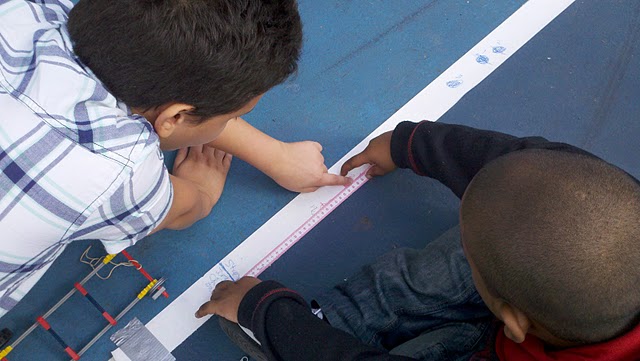
Well, time has passed and the kids are now learning about different kinds of energy--and experimenting with it. One project they've done is to explore the questions: How will rubber band energy affect the movement of the little cars they built? And how will twisting the rubber bands more and more affect the movement as well?

To do the experiment accurately, the kids had to set up a system of measuring their results. They made tracks outside in the school yard.


Then they marked the distances along the track.


Next they twisted their rubber band a certain number of times.


Ready...
Set...
GO!


Of course, the question was: How far did it go? The kids had to measure the distance and record the results.


Then they had to try twisting the rubber bands more and more and record what happened. They found out that more twists = more energy = more distance. They also learned about two specific kinds of energy. You can read what they wrote about it below.


Friday, October 22, 2010

It's Energy Week, Day 5

Our fourth and fifth graders will be studying different concepts of energy in their science curriculum throughout the year. Luckily their science teacher, Ms. Ripley Daniels, recently spent time in Japan on a Fulbright Fellowship to learn about "education for sustainable development", which includes notions of green living. Just as luckily, our students have a living laboratory right outside their classroom windows, where they can watch and talk to the people who are designing and building homes that will reduce Old Colony's energy footprint.

Ms. Ripley Daniels started the unit by asking her students to describe what they think energy is and where they think energy comes from. We'll be watching them learn much more about these questions all year long.

Remember, you can click on the pictures to make them bigger.

Here are Jaymil's thoughts:


And Dario's ideas:


This is Christian's take on the matter:

Thursday, October 21, 2010

It's Energy Week, Day 4

Our fourth and fifth graders will be studying different concepts of energy in their science curriculum throughout the year. Luckily their science teacher, Ms. Ripley Daniels, recently spent time in Japan on a Fulbright Fellowship to learn about "education for sustainable development", which includes notions of green living. Just as luckily, our students have a living laboratory right outside their classroom windows, where they can watch and talk to the people who are designing and building homes that will reduce Old Colony's energy footprint.

Ms. Ripley Daniels started the unit by asking her students to describe what they think energy is and where they think energy comes from. We'll be watching them learn much more about these questions all year long.

Remember, you can click on the pictures to make them bigger.

Here are Sumeya's ideas:


These are Autumn's thoughts:

Wednesday, October 20, 2010

It's Energy Week, Day 3

Our fourth and fifth graders will be studying different concepts of energy in their science curriculum throughout the year. Luckily their science teacher, Ms. Ripley Daniels, recently spent time in Japan on a Fulbright Fellowship to learn about "education for sustainable development", which includes notions of green living. Just as luckily, our students have a living laboratory right outside their classroom windows, where they can watch and talk to the people who are designing and building homes that will reduce Old Colony's energy footprint.

Ms. Ripley Daniels started the unit by asking her students to describe what they think energy is and where they think energy comes from. We'll be watching them learn much more about these questions all year long.

Remember, you can click on the pictures to make them bigger.

This is what Matthew thinks:


Here are Najwah's ideas:

Tuesday, October 19, 2010

It's Energy Week, Day 2

Our fourth and fifth graders will be studying different concepts of energy in their science curriculum throughout the year. Luckily their science teacher, Ms. Ripley Daniels, recently spent time in Japan on a Fulbright Fellowship to learn about "education for sustainable development", which includes notions of green living. Just as luckily, our students have a living laboratory right outside their classroom windows, where they can watch and talk to the people who are designing and building homes that will reduce Old Colony's energy footprint.

Ms. Ripley Daniels started the unit by asking her students to describe what they think energy is and where they think energy comes from. We'll be watching them learn much more about these questions all year long.

Remember, you can click on the pictures to make them bigger.

This is Brianna's page:


Here are Al's ideas:

Monday, October 18, 2010

It's Energy Week, Day 1

Our fourth and fifth graders will be studying different concepts of energy in their science curriculum throughout the year. Luckily their science teacher, Ms. Ripley Daniels, recently spent time in Japan on a Fulbright Fellowship to learn about "education for sustainable development", which includes notions of green living. Just as luckily, our students have a living laboratory right outside their classroom windows, where they can watch and talk to the people who are designing and building homes that will reduce Old Colony's energy footprint.

Ms. Ripley Daniels started the unit by asking her students to describe what they think energy is and where they think energy comes from. We'll be watching them learn much more about these questions all year long.

Here's what Beatrice wrote:


This is Lyonceh's take on the matter: